
What a week! Tuesday’s results changed who holds the pen, the levers, whatever metaphor you want, on data centers in about a dozen states. The attention has gone to who won seats in Congress, but the most impactful moves happened down-ballot.
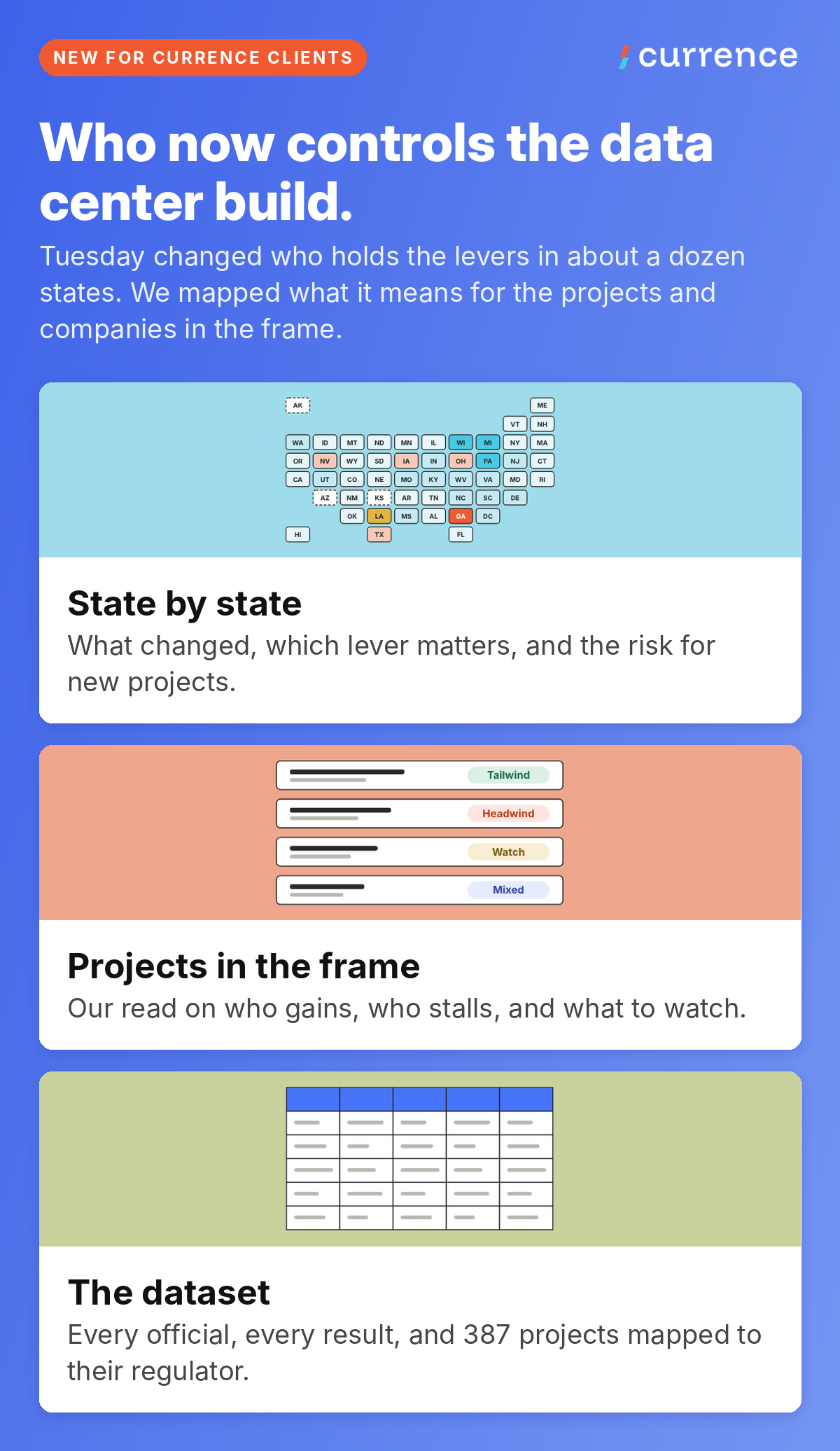
We’ve been tracking every official with a hand in the build. This morning we published the client update of the analysis and dataset – who now controls each lever, state by state, and our read on what it means for the largest projects. Read on for our take, or talk to us for the client version.
This is Currence’s weekly newsletter on the moves and motives shaping the load growth era. Not a subscriber yet?
Post-midterms, the 75 seats that matter
What happened
In September, we mapped every election for officials with a hand in the data center build, and updated it with the winners today. Utility regulators were on the ballot in some form in 38 states this cycle. Most of those races are now called, and the biggest moves for data centers came down-ballot, in the often-overlooked races for utility commissioners.
Popularly elected commissions. (10 states, 9 with races, 15 seats up)
Georgia. Peter Hubbard (D) held District 3, and Shelia Edwards (D) won District 5, flipping the PSC from 3 Republicans and 2 Democrats to 3 Democrats and 2 Republicans, the commission’s first Democratic majority in decades. It’s Democrats’ second gain in two years: a delayed 2025 special election, which Hubbard also won, cut a 5–0 Republican commission to 3–2.
Nebraska. Wendy DeBoer (D) won the open District 2 seat about 68–32, flipping it from Republican and cutting the commission to 4–1 Republican.
Louisiana. Stephanie Hilferty (R) held District 1, and John Atkins (R) won District 5, a seat an outgoing Democrat, Foster Campbell, had held. That gives Republicans a fourth seat on the five-member commission.
Oklahoma. Brad Boles (R) held the Corporation Commission seat.
Alabama, Montana. Republicans lead all four seats up across these states, though AP hadn’t called any as of 9:30 a.m. ET. Montana’s District 5 was the closest, with incumbent Annie Bukacek (R) ahead 53–47 with all precincts in.
North Dakota. Incumbent Republicans Sheri Haugen-Hoffart and Jill Kringstad lead about 61–39 with all precincts in, though AP hasn’t called either seat.
Arizona. Democrats Clara Pratte and Jonathon Hill lead for both at-large Corporation Commission seats, with Hill about 103,000 votes ahead of incumbent Kevin Thompson (R) for the second. Republicans keep a 3–2 majority either way, since the commission was 5–0 Republican going in.
South Dakota. Not yet called, though Republican Don Haggar leads 60–40 with all precincts in.

Legislature-selected commissions. (2 states, 10 seats total) South Carolina’s 7-member PSC and Virginia’s 3-member SCC are both officially nonpartisan bodies, elected by the state legislature: Republican-controlled in South Carolina, Democratic-controlled in Virginia. Neither had a selection tied to this cycle.
Hybrid, governor-appointed but with checks. (10 states, 8 with governor’s races, about 16 seats to fill by 2030, not counting Massachusetts and Tennessee, where the governor shares the pick)
Ohio. Amy Acton (D) beat Vivek Ramaswamy (R). She’ll fill four of the five PUCO seats by 2030, though each pick must come from a nominating council’s slate.
Texas. Gina Hinojosa (D) beat Greg Abbott (R), giving Democrats appointment power at the PUCT for the first time in three decades. Every pick still needs confirmation from the Texas Senate.
Alaska. Headed to ranked-choice tabulation. A win for Jonathan Kreiss-Tomkins (D) would flip the office, though his appointees would still need the full legislature’s confirmation.
Massachusetts, New Mexico, New Hampshire, Vermont, Tennessee. No change in party. Healey (D), Haaland (D), Ayotte (R), Scott (R), and Blackburn (R) won, and each state adds a check on the governor’s picks, from nominating panels to confirmation votes.
Straightforward governor appointment. (28 states, 21 with governor’s races, about 59 seats to fill by 2030)
Iowa. Rob Sand (D) beat Zach Lahn (R), flipping appointment power.
Nevada. Aaron Ford (D) beat Joe Lombardo (R), flipping appointment power.
Kansas. Still uncalled. Cindy Holscher (D) leads Ty Masterson (R) by about 7,000 votes with all precincts in, and mail ballots that arrive by Friday still count.
14 states held Democratic, and 4 held Republican.
Tuesday’s governors will fill about 75 utility commission seats by 2030, the count we flagged in September. Democrats won the power to fill about 59 of them, including 12 that flipped from Republican appointers in Ohio, Texas, Nevada, and Iowa, and six more hang on Alaska and Kansas. In Georgia, voters handed Democrats control of the commission outright, and in Nebraska they flipped a seat.
Mark’s take
Well that was wild, right? I don’t think anyone really expected what we saw on Tuesday. I mean, some pods I listen to, someone would say 54 to 55 for the Senate, then immediately get dressed down. But here we are.
But coming to the data center build. We’ve said it before, and doubling down here – the chatter will be about moratoria, but the legislation that passes will be about who pays.
Tuesday’s winners are energized, and data centers are an animating issue, one where they can show they heard the voters. Expect bills as early as January proposing pauses. And the fastest pause doesn’t need a legislature at all. Abbott halted Texas air permits for data centers with a single directive, and on 19 January that pen is Hinojosa’s. But the moratoria or pauses will likely have little effect. They’ll likely land in states with limited data center development, like Michigan, and projects already in development will likely be grandfathered in. Pennsylvania and Wisconsin are the ones to watch, with big projects in the works. And there’s definitely room for the excitement to bleed over into states with considerable development, like Virginia, which has had a Democratic trifecta since January.
But again, where the trifectas will come through is on who pays. We fully expect bills early next year on who pays, so that state residents benefit more fully, and financially, from the data centers built in their states. Legislators can draw a clear line from these bills to being tough-but-fair on data centers, and to the affordability message that got them elected.
And those bills get carried out at the commission. So, you gotta watch the commissioners.
Who this helps
Bring-your-own-power developers in Pennsylvania. Shapiro’s GRID standards favor projects that supply their own power, and he now has a trifecta to back them.
Ratepayer advocates in Georgia. Hubbard and Edwards ran on data centers paying their fair share, and they hold the PSC majority from 1 January.
Projects already permitted. Most pauses so far grandfather what’s already approved, so the risk sits with the announced pipeline.
Who should be nervous
On-site gas developers in Texas. Their path runs through TCEQ air permits, which Abbott paused in September with a single directive, and Hinojosa campaigned on a moratorium.
Large loads waiting on Georgia Power. The next contracts go to a new majority that wants enforceable ratepayer guarantees.
Developers in New York. Hochul’s win keeps EO 62’s halt on new permits in place, and she fills the whole PSC by 2030.
Meter reading (30 Oct - 1 Nov)
A quick read on the numbers shaping the market. The capex, the contracts, the regs, all anchored in the so-what.
1GW // OpenAI’s curtailable share of the 3.2GW it expects to draw at its first wholly owned data center campus, in Effingham County, Georgia, under a 25-year contract with Georgia Power disclosed through the company’s new Grid Protectors Program. Georgia Power is pricing the flexibility in and projecting roughly $950m a year in portfolio savings. It’s the largest curtailable large-load commitment disclosed to date.
84GW // AEP’s contracted large load through 2031, up from 69GW last quarter, alongside an expanded $100bn five-year capital plan that includes $37bn of transmission and $36bn of generation investment and lifts rate base growth guidance to a 13%-plus CAGR. Contracted is the word to watch, since it counts customer commitments rather than energized load. The constraint is how much new generation AEP still has to build to serve it.
$78bn // Caterpillar's record Q3 backlog, up from $39.8bn a year earlier, with power generation sales up 30% to $3.42bn on data center demand for engines, generators, and turbines. Management says some large gas power orders now stretch to 2029 and 2030, and that Caterpillar is expanding production of large reciprocating engines and turbines. Shares still fell about 9% on 29 Oct because Caterpillar held full-year guidance instead of raising it.
Explore more Signals on Currence here.
On the docket
The policies, rulings, and company moves worth watching.
Senate plans a Monday vote on bipartisan permitting reform despite a Democratic landslide weakening its odds. Sens. Whitehouse and Heinrich are pushing the Bipartisan American Affordability and Jobs Act to a November 9 floor vote, but Rep. Huffman wants Democrats to hold out for a stronger bill once they have more leverage. The bill would speed transmission siting and make data centers fully cover their own grid upgrade costs.
CPUC orders PG&E, SCE, and SDG&E to design a shared DER orchestration framework. It directs the three utilities to propose common rules for coordinating customer batteries and EVs as distribution system operators, and to add load-flexibility scenarios to distribution planning starting with the 2028-2029 cycle. No dollar figure yet, but the framework will decide how much of California’s behind-the-meter capacity counts toward resource adequacy.
Dominion and NextEra reject a multiyear rate freeze ahead of their SCC hearing. The companies accepted 101 of 117 conditions regulators and the Attorney General’s consumer counsel attached to the $67bn merger, including bankruptcy ring-fencing tied to a NextEra credit downgrade, but rejected Gov. Spanberger’s six-year residential rate freeze, a competing three-year rate moratorium from SCC staff, and a 10-year Virginia headcount commitment. Commissioners will rule by January 15, 2027.
New & upcoming at Currence
The latest research, features, and data drops on the Currence platform.
SPACs are back, with 27 deals in play in 2026. Climate tech SPACs have rebounded this year, more than triple 2025’s total, with nuclear leading the pack on data center power demand and 16 more deals waiting to close. The piece traces the 2020-22 boom’s wreckage and runs the current pipeline through a filter of revenue, committed private money, and trust cash to flag which of the pending deals are likely to close versus likely to stall. Read the full analyst take.
Events
Where the market is meeting, and where to find us
📅 RE+ // Las Vegas, Nov 16-19 // North America's largest clean energy event, covering solar, storage, hydrogen, and grid edge tech. Respond to this email if you’ll be there, too.
The B-side
A few weeks ago I was out for a run. While running across Hammersmith Bridge, Birdhouse in Your Soul by They Might Be Giants, came on my Spotify. Immediately, the song put me into such a good mood. Felt weightless, and ran fast. This week has me feeling a bit like that.
Full Powerstack B-Sides on Spotify.
Interested in diving deeper? Talk to our team and learn how the teams that finance and build the energy system use Currence to stay ahead in the energy and AI buildout, including Southern Company, Tokyo Gas, Jefferies, Galvanize, B Capital, and others.
